Friday, 27 January 2012

Super Smash Bros. Melee - Mechanics, Dynamics, and the overall system

One of the games that I spent a considerable amount of time playing back in the day was Super Smash Bros. Melee. This was the sequel to the original Super Smash Bros. game for Nintendo 64 (made for the Nintendo Gamecube).

The game involved choosing a specific character to play as, where characters were various Nintendo gaming franchise characters such as Mario, Link, Fox, Donkey Kong and Kirby, and using them to knock other players out of the stage boundary using various moves. The game stages were 2D and characters were only allow to progress forward and backward.

Mechanics:
Each character had their own unique set of skills, as well as common moves between all of them. Every character had the same buttons for jump, block and basic attack (punch or kick). Contrary to traditional fighting games, the player inflicting the most damage does not guarantee victory. The objective of the game is to knock the opponents outside of the stage boundary. The most damage a character accumulates, the increase in likelihood that he/she will experience stronger knock back effects. Any type of attack in game causes a knock back effect where the magnitude of the effect is determined by the amount of damage the receiver has already accumulated.

Dynamics:
Throughout the course of a fight, there are many external factors which affect the tide of the battle. Two main factors, the stage where the battle is being fought and random appearances of items are dynamic events which randomly happen and can affect the result of the game. One obviously example, is when the characters fight in the Starfox stage where they are fighting on top of a gigantic battleship from the Starfox franchise. Starfox fighter ships will randomly spawn during the battle and start to shoot at the characters. If a character was caught of out position (shot by the fighter ships), he/she might end up accumulating a enormous amount of damage, allowing their opponents to have an easier time knocking them out of the stage.

The overall system:
There are many many different stages to choose from, and there are some stages where there are no dynamic affects which allow the battle to be less influenced by the stage. Each character in the game is somewhat balanced, characters that do lots of damage have a harder time landing their attacks, and ones that do less damage, are typically more swift. This allows the overall system of the game to appear fair which allows it to attract a wide audience of players. The move executions are standard across all characters, making the variety of characters that a novice player can choose to be numerous. Of course, this game also scales for hardcore players as well, since lots of moves can be strung together for combos, skills can be parried and dodged as well. The fighting is also very fast paced, which makes the gameplay more intensive and focused. I believe that the ability to create a game which is easy to pick up for new players and be able to retain them by having a high skill ceiling to reach is an ideal focus for a game, as shown by the incredible popularity of this game.

Bubble Tanks Tower Defence - Gameplay Mechanics

Bubble Tanks Tower Defence is a highly addictive web-based tower defence game. The object of the game is simple: prevent the enemies from reaching their desired destination by building towers that slow down or destroy them. The game is easy to pickup and play, but maddeningly difficult to master.

Defense of the Ancients Gameplay Analysis

As a relatively recent genre of video games, the MOBA (Multiplayer Online Battle Arena) has evolved from its RTS engine roots and emerged into a fully developed genre by itself. The most widely played MOBA game of all time, Defense of the Ancients or as many players called it - DotA - is a highly complex and competitive online multiplayer game.

A quick, top down, general description of the game would describe it as a tug-o-war style game between two sides with equal amount of players on each side. The goal is to conquer the other team by successfully destroying the main artifact (structure). Each player controls a hero selected at the start of the match. During the course of the match, the hero gains gold and experience to enhance their heroes with items and leveling up skills.

At every multiple of 30 seconds since the start of the match, monsters - known as "creep" - spawns from the base of each side. These "creep" cannot be controlled by the players directly, and will attack (rather unintelligently) in a direction in each of the three distinct paths (commonly referred to as "top lane", "middle lane", and "bottom lane").
Killing enemy creep will result in experience and gold for the hero. It is also worth noting that gold will only be awarded to the hero if and only if the hero is the true killer of the creep by executing what is known as the "last hit" on the creep.

The goal of the game is to earn gold to buy items which grants different attributes and abilities, and experience in order to defeat the enemy team. Killing enemy heroes will result in more gold bounty than killing creep, and also result in much more experience depending on level of the hero killed.

In the most general sense, the goal of the game is quite simple. However, the level of mechanics involved in this game is far too complex to comprehensively describe in this blog post.

Mechanics

To start off, I will be discussing some of the main mechanical details of the game.

Hero Attributes

Each hero has three different values for attributes: Strength, Agility, and Intelligence. A hero also has a primary attribute, allowing the hero to gain 1 point of damage per attribute value. Each attribute also corresponds to different statuses of the hero: Strength to Max HP and HP regeneration, Agility to Attack Speed and Armor, Intelligence to Max Mana and Mana regeneration. Other attributes include Movement Speed and Attack Range.

Controlling Your Hero

In order to control your hero in a DotA game, the interface, keys, and controls are similar, if not equal to a typical Real-Time Strategy game. You select your hero, move with right click and have commands such as Attack, Move, Stop, Hold Position, as well as other skills.

Hero control is crucial in playing the game well, and plays a large role in survival, acquiring "last hits" on creep, and timing.

Purchasing Items

Each hero is able to purchase items from the shop at their base. Each items have unique abilities and grant the hero different attribute bonuses, special effects, or even skills. Generally more powerful items require much more gold to purchase, which is why it is important to gain plenty of gold.

Using Skills

Skills are unique to each hero, and each skill can be either "Active" or "Passive", with the difference being Active skills require user input to function, while Passive skills are always in effect once leveled. Most Active skills require Mana to cast and have different cool downs (periods of which the skill cannot be recasted).

Dynamics and Metagame

DotA gameplay is complex due to the the level of metagame required to be understood before graduating from the "novice" level of play.

Multiplayer

DotA is a multiplayer 5v5 game, requiring 10 players to play. As a result, in order for a decent match to be played no player should leave the game. The skill level of each player should be equal to ensure a fair game. Due to the competitive nature of the game, flaming other players, insults, and rants are often rampant across the DotA community. Hence, DotA is dubbed as one of the most hostile environments for novice players, and a breeding ground for bad mannered players.

Popular Mechanics for Kids


Tactics Arena Online is an online, 2-player, turn-based strategy game that is like an animated version of chess. Each player controls up to 10 units and uses their abilities to try and kill the other player's units. There is a single game map which is tile-based and square-like in shape. Players can choose how to arrange their units on the map, and which units to use via their game settings before battling other players. These arrangements can easily determine the winner of a match, so players usually put some thought into the placement of their units. Defensive players often place their units close together and by a corner of the map in a tight group, whereas offensive players might place their units aggressively in the middle of the map closing the distance between themselves and the enemy player. Players can also choose a colour scheme for their units to distinguish between themselves and other players' units.

Choosing which units to use is also an important part of the game strategy. Even though there is a limit of 10 units per player in a game, each player is initially given 12 units of 9 distinct types to choose between. Additionally, paying game subscribers have access to 9 more unique units (Say that 5 times really fast). Each unit has different attributes, abilities, and frequency of use. For example, a Knight has high defence increasing its chance to block physical attacks, and it also has high power inflicting strong attacks upon enemies. A Knight also has a high frequency of use meaning that once you perform an action with it, you only have to wait 1 turn before using it again. Typically, strong units have a low frequency of use and you have to wait several turns before using them again making it important to use them wisely.

Players enter a battle by selecting an empty arena from the game lobby and waiting for another player to join them to start the match. A randomly selected player is chosen to move first and they select a unit to move or attack. A typical move involves moving a unit to a position of attack, attacking an enemy unit, positioning the unit defensively, and then ending that player's turn. This repeats back and forth until one player defeats all the units of an enemy or if a player surrenders and leaves. Each player is given a time limit of 1-2 minutes to perform their turn otherwise they are forced to pass.

The high structure and clearly defined rules of the game make it easy to play and learn after a few matches. The game itself is fairly static, but the gameplay is dynamic in the sense that no 2 matches are the same. You cannot predict how your opponent will move, so players learn to think critically and create strategies to outmaneuver their enemies. Also, each player has their own ranking. Win a match and your ranking increases; lose and it goes down. Leaderboards with the highest ranked players are displayed on the game's website encouraging players to keep playing for bragging rights. So what are you waiting for? Go and play TAO!

Castlevania: Dracula X Gameplay

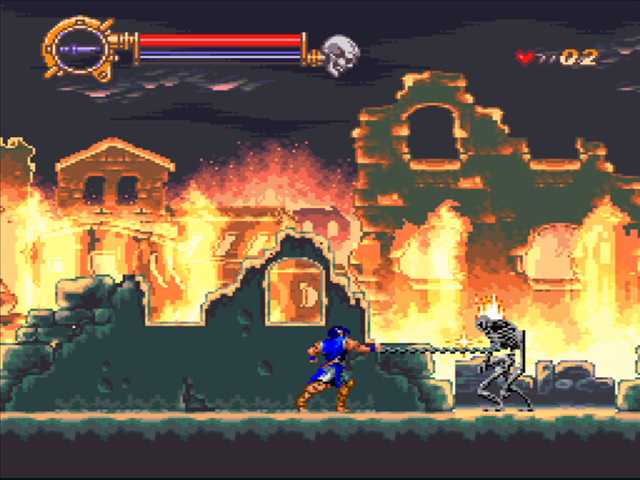
In Castlevania: Dracula X (Super Nintendo), the mechanics are simple relative to many games made for modern consoles today. The player takes control of a vampire killer who must defeat Dracula by progressing through six levels that are set in Dracula's castle. The player may move from side to side, although progress through the game is largely left to right. The player may also jump. Jumping can be combined with lateral movement for three different types of jumps. One, a simple jump in the air (no lateral movement). Two, a jump followed by a direction (slight lateral movement). And three, lateral movement followed by a jump resulting in a considerably long jump. Once a player has jumped, just like in the real world, they cannot change the direction they are moving. This adds an extra challenge in the game since moving platforms and enemies force the player to think before commiting to a jump. The player can also attack with a whip. The player must be directly in front of the enemy to attack them with the whip. Jumping and whipping can be combined to hit enemies that are on different levels than the player. There are also a number of other weapons that allow the player to attack enemies above and below the player, but only one of these weapons are be carried at a time so the player must choose carefully which one they should take. Also, these weapons can only be used a limited amount which adds to the difficulty of the game. The player only has 3 lives to beat any given level. If they die at some point in the level, they restart in the room they died in. If they die and they don't have any extra lives, they restart the level from the beginning. A password system is used to recover the player's progress should they become frustrated with the game. Finally, a note on the enemies is necessary. The "bad guys" in the game all move in a predictable pattern, but they also adapt their pattern according to the player. For instance, one enemy might throw axes at the player while the player is far away, but as soon at the player comes close the enemy charges forward like a bulldozer on red bull.

EDIT: The preceding blog entry was necessarily brief and did not delve into detail that would do the game justice.
A screenshot of Castlevania: Dracula X

Wednesday, 25 January 2012

Assassin Creed BrotherHood Gameplay

Desmond Miles lies on Animus which allows him to explore and experience the memory about his ancestor Ezio/Altaïr kept in his DNA. The synchronization level of Animus and Desmond only allows him to explore small portions of his DNA. Through exploring these DNA, Desmond increases his synchronization level allows him to access more memory.


The gameplay switches between present and past but focuses mainly on the past. When the game enters a sequence of the past, the interface changes; there are weapons selection (on the bottom left of the screen), Enzo’s health and armor indicator, and your wanted level. The user controls Ezio who is an Assassin. The game uses a mission structure to follow the main story, where Enzio is assigned missions. The user can choose to accept or decline this mission. However, users can only accept missions that are critical to the story line. There is a large variety of missions, from assassinating public figures, stealth missions, recruiters people to join the Assassin organization, eliminating Borgia authority by killing the Borgia captains, to buying stores to improve the society/city.


The game uses active and passive modes. Actives modes allows the user to free-run, climb, and assassinate. However, these high-profile actions will increase your wanted levels and catch the guard’s attention. Passive modes allows users to blend into the crowd and pickpocket. If a guard sees you, there is a green indicator that display the guard’s level of suspicion of you. The guard notifies and attempts to murder you when the indicator turns red. The user can either eliminate all of the guards, or hide in spots like well and haystacks. However, there are guards that specifically check the haystacks. If the guards do spot Enzo hiding in the haystack, the guards will immediately attempts to convict you.


Performing actions that is against’s the Assassin’s policy will indicate a warning, a repetition of these actions will result in breaking the synchronization. There are also certain parts of the map that Ezio cant accessed. A brute force of accessing will also result in breaking the synchronization. When Ezio’s health indicator reaches zero, the synchronization also breaks. Breaking the synchronization will reset the uesr’s last checkpoint.

Friday, 20 January 2012

Major Deliverable Level 1 Complete!

The complete deliverable file can be downloaded here

Check out our game pitch video below (kudos to Carmine and his awesome video editing skills)


And we also have a shiny new logo!

Sunday, 15 January 2012

Setting up Android Dev Environment in Eclipse

Here's how to setup the Android SDK with Eclipse Indigo to get started with Android development. Here's what I'll be using for the setup:
  • Apple iMac OSX Leopard (10.5.8)
    • The process should be similar for any OS
  • Eclipse Indigo (3.7)
    • The following instructions may work with older versions, but I'll be using Indigo
    • http://eclipse.org/downloads/ (the 'Classic' version should be fine)

Tuesday, 10 January 2012

Carmine's Opinion on Video Game Worlds


I really think that the one thing that has really kept me captivated in my gaming experiences is the story and the world that is created by the game. I always wished there was some way to transport myself into the world of the video game I was playing when I was a kid. Video game worlds are rewarding and challenging at the same time. The world of Link in the Legend of Zelda is complex and vast. It is easy to get lost in the mythology that is created by the game developers. Indeed, watching the story unravel is a motivating factor for beating the game.
I bring up the example of The Legend of Zelda because it is one of my favourite games and I have played the series extensively. In addition to beautiful environments, the "world" of the game is constructed with its own mythology. There are different races of people, all with their own myths and legends. There are ancient artifacts that have origin stories. There are the main characters themselves who each have a story to tell in their own right. All of these details contribute to an intriguing world that enthralls the player. Another example I choose to present is the Castlevania series. This horror movie-inspired series presents a classic good versus evil conflict that pits a family of vampire killers against the Count Dracula. The environment is dark. The music is eerie. The monsters are frightening. The game is awesome. The overall mood is achieved much in the same way that moods are created in movies: set design, music, costumes, and props. The video game equivalents are: level design, music, characters (including enemies), and weapons.
I have expanded on why I think the world created in a video game is essential to its success in the preceding blog entry. At this point I would like to address the fact that casual gamers often do not require such an in depth story or detailed world to enjoy a game. Take Angry Birds as an example. I’m pretty sure the story is “the birds are angry, and they don’t like pigs”. It works. It’s weird, but it works.

Monday, 9 January 2012

A Nostalgic Game

Throughout the course of my time here on earth, there has been a number of games which have helped develop my exquisite taste in gaming. If I were to sit here and write about each and every one of them, it would surely exceed the 100-300 word limit of this assignment. Therefore I'll only talk about one title which have really established a comfortable niche in the back of my mind, here it goes...

Pokemon Red - Pokemon is arguably the most virulent franchise ever created, and has acted as a gateway drug by further leading me into their game sequels (many and many of them), trading card games, competitive tournaments, books, TV Shows, and even fancy apparel. The game had an addictive element, I remember fighting my brothers for playtime on the Game Boy and freaking out when we lost a save. What parts of it did I enjoy the most? Collecting all the different types of Pokemon? Breeding them? Pokemon Battles? Beating the Elite 4? or successfully capturing rare Pokemon (Mewtwo without using a Masterball)? None of these aspects alone can really define the addictive nature of the game, but collectively, they are able to strongly captivate and bind the player. You can find many aspects of the Pokemon game in many other games, but what Pokemon excels in is its ability to mesh everything together, the "unique" battle system, the story, side stories, an expansive/explorable world, and of course, incredible art work.

Due to the limitations of handheld gaming technology at the time (we had to buy link cables to physically link up Game Boys to play with other people), the multiplayer component of the game was deeply crippled and not a core aspect of the game. There has been great changes to the landscape of the gaming industry since Pokemon, and modern games now put great focus on adding social and multiplayer features. It is incredible to think that if the Pokemon franchise had been launched around this day and age, will it still be able to achieve the same insurmountable success that it had 10 or so years ago? The answer is probably no!

Sunday, 8 January 2012

Rob's Fave Games

I have never been a big gamer, but there have been a few games that have really connected with me at some point in my life. Here's a quick look at three of them.

NHL - EA Sports

EA's NHL series was the first video game I really became obsessed with. It started with NHL '95 on the Sega Genesis. Looking back, the graphics were atrocious, but at the time it was hard to imagine wanting anything more. I think that the entertainment value of this game comes from the competitiveness it brings out in people. It's about getting together with your friends, picking your favorite teams, and trying to beat the crap out of each other. The internet makes it even easier to connect and challenge others now. I regularly play (and beat) my brother who lives in Winnipeg, and it's simple to connect with strangers at your skill level who live across the world.

Civilization - MicroProse:

Civilization is the most addicting game I have ever played. It has amazing ability to suck me in and not let me out, no matter how much I want to quit. For me, the game is about validating my thoughts, ideas, and strategies. I want to see how my decisions play out, to simulate a world where I am the king. The most enjoyable part about the game is that there does not seem to be one 'best way' to play it; any strategy has a chance each game.


Madden - EA Sports:

The Madden series has similar qualities to the NHL series. The competitive aspect is still a major part of the game, but for me, Madden is more strategic. Like a real NFL game, it's about keeping your opponent off-balance with your team's play calls. The time to make decisions is very limited, and like the games above, there is more than one path to victory each game.

Video game vs regular software development!

Video-game development are not that much different from regular software development. Both the terms video game and regular software are vague can vary from various factors such as regular software development that varies from the target audience, the intended amount of users, the software’s purpose and the characteristics of this software itself but the fundamentals are the similar; both development are planned (product development life-cycles, iterations), execution and maintenance.


Most game development probably undergo agile lifecycle; the iterations are short and there are many features to demo at the end of each iteration. On the other hand, some regular software development are developed from waterfall lifecycle.


Video games can be played in consoles and portable gaming devices so technically video games developers have more variety of platforms to develop from. If developers were to develop on those gaming devices or mobile devices, the games will be restrained to limited resources, which means that the code has to be very efficient. In order to achieve that, the development process might increase coding reviews and measuring efficiency.


Modern games now have very cool graphics( except for some games like minecraft) so developing graphics are emphasized more in video games development. There are many new technologies that produces good graphics. Sports games (well,at least EA does) develop players movement through motion capture. Besides motion caption, there are many game engines that develops good graphics too. A good example is Unity. Aside from graphics, good games often require no lag and quick response time so again resource allocation efficiency can also be a major component in video game development.


Lastly, due to nature of the video game market, video game strict release deadlines, which differs slightly with regular softwares, so video games development tend to be more stressful when near to the release date.

Saturday, 7 January 2012

Fun

Of course, it's not that simple when you try to define "fun" in the video game industry. Everybody is different, there are casual gamers, hardcore gamers, wannabe hardcore gamers, or most commonly just plain noobs. I'm sure all our mothers have told us at one point or another in our lives that we are all special in a certain way. Well she's right. Fun is different for everybody, a game that is considered fun to most people may be the most boring crap in the world to another person. To each their own.

I play a lot of games ranging from genre to genre, and for each genre there are specific elements that I find enjoyable. A simple example would be the competitiveness of an MMORPG game. I used to be "that guy" on Ragnarok Online who would analyze each and every aspect of the PvP metagame to become the ultimate PvPer. I was famous, and I loved it. To others it would be nowhere close to "fun", I would even go as far as using calculus to figure out the best builds and damage combinations. At one point I even developed a small piece of software to simulate and tune builds for optimality. This sense of extreme competitiveness was enough for me, it was exhilarating to be respected and feared at the same time. Would this be fun for everyone? I strongly doubt it. Hell, you'd probably think I'm a total nerd by now. But this sort of perspective perfectly illustrates the grand differences and how difficult it is to quantify "fun" in its general sense.

The real question is, how do we quantify a certain level of "fun" for the people who do enjoy a certain game. All video games are different, even if their sequels seem exactly the same (I'm calling you out Call of Duty) but what makes things fun? Are the elements of a video game that make it fun transferrable? I like Portal. I think it's fun. I don't like Angry Birds, I think it's boring. What if Angry Birds had portals in it? Would that make it fun? To some maybe, but personally I think that would be absolutely stupid.

So how do we make things fun? Honestly, I don't believe there is an actual formula for fun. It's entirely subjective, and that's the beauty of video games. There is seriously something for everyone. You like driving? There's Gran Turismo 5. You like trains? There's Train Simulator 2012, I kid you not. You want a game that you can rage over the NPC blocking the doorway? Welcome to Skyrim. Of course, not everybody will enjoy a game for the same reason. Or perhaps, a person can enjoy a game because of a certain element, yet dislike another for the very same element.

The next time you ask a friend "Is ____ fun?" you'll realize your question can never have an accurate answer. Just play it and find out for yourself.

From Google:

fun/fən/

Noun:
Enjoyment, amusement, or lighthearted pleasure: "anyone who turns up can join in the fun".
Adjective:
Amusing, entertaining, or enjoyable: "it was a fun evening".
Verb:
Joke or tease: "no need to get sore—I was only funning"; "they are just funning you".
Synonyms:
noun. amusement - joke - sport - jest - lark - entertainment
verb. joke - jest - banter - jape - lark

Three video games that changed my life

Final Fantasy VII

I got my first console by trading my Pokémon cards for 2 Gameboys and some random games. Then I traded the Gameboys & games for the original PlayStation, NHL '98, and Driver 2. (Who says the bartering system doesn't work?) Anyways, the PS2 had already been released and finding original PS1 games was becoming increasingly difficult as they had started to become phased out. It was just my luck that the Real Canadian Superstore still carried PS1 games, and it was here that I found Final Fantasy VII, The Legend of Dragoon, and Syphon Filter 2 at bargain prices.

I had never played a Final Fantasy game before, and I didn't know what to expect from the game I had just purchased. The cover and the description on the back of the case looked promising, so I took a chance and spent the money I had saved from chores and birthday gifts. Boy, did I ever get my money's worth. The first night, I couldn't put the controller down, and I became immersed in a story that captivated my imagination. The graphics were so-so, the cutscenes were amazing, the combat system was exciting, but the story was what had me hooked. I found myself developing an emotional connection to the characters, and I played the game religiously everyday after school. When I reached the end of the first disc, I was shocked to find that Aeris (or Aerith depending on who you ask) was killed by the big bad guy, Sephiroth. This was the first time I ever felt sad for a character in a game, and it drove me to keep playing and chase Sephiroth through this beautiful, fantasy world.

The main character Cloud cradling Aeris after Sephiroth had run her through with his sword

What worked really well for FF7 was the ensemble cast of characters and the story-telling ability of the game developers. Like a good movie, each of the characters develops as the story unravels and you find yourself either loving or hating them. As you play through FF7, you find yourself visiting the home towns of your party members and exploring their backstories and identities. The developers found just the right balance of plot and action to make this game addicting and one of the most highly rated games of all time. I still find myself dusting off the game and playing from my save point before the final confrontation with Sephiroth in the Northern Crater.


RuneScape

It was 2001 and I was in the 7th grade when my friends told me about RuneScape and asked me to play with them. At the time, I had played very few PC/online games with the exception of Neopets (Yes, I was that guy) and I didn't know what lay in store for me. Like FF7, I became addicted, but this time, the reasons were different. I wasn't particularly awed by the story in RuneScape, yet I became obsessed with the online play and the character progression that drove me to keep grinding level after level.

The online experience was uncharted territory, and I loved every second of it. It was only a decade ago, but the Internet was a different place and people were much nicer and a lot less cynical than compared to today. I found myself not only playing with school friends, but complete strangers from across the globe.

One aspect of the gameplay that I particularly enjoyed was the player vs. player (PvP) combat. In RuneScape, there was a designated area of the game world called "The Wild" where you could attack and kill other players and not just computer controlled monsters. If you attacked another player, you would become flagged and have a "skull" hovering over your head. Kill another player that is "skulled" and you get all their items. Die while skulled, and you lose all your items. If you die while "unskulled" you keep your 3 most valuable items. The Wild became a place where friends and enemies co-existed in an intricate balance of life, and the risk vs. reward element was highly captivating.

Fourty some odd members of my clan just before engaging in a war with another clan

The Wild was a dangerous place and by yourself, your chances of survival were slim. Most people would form teams and split the loot obtained from shared kills. I was one of those people, and with some newly-made friends, we formed a strong team and dominated everyone in our level group. We ultimately decided to make the team official and turned it into a clan. As a clan, we recruited more members and organized massive wars with other established clans. At our peak, we had 70 members and were undefeated in our war history. This form of group play was definitely the highlight of my time as a RuneScape player. There was a strong feeling of kinship and camaraderie between clan members and many competitive rivalries developed between clans.

Unfortunately, the same character-driven gameplay of RuneScape that had kept me hooked had started to bore me. The constant leveling had led to burnout, and I wasn't having fun when I wasn't participating in clan activities. Also, the game controls were very limiting. Everything was accomplished with mouse clicks with the keyboard only used for chatting. You would click to move, click to fight, click to use items, and click, click, click... That, combined with the outdated Java graphics, eventually made me quit RuneScape and move on to World of Warcraft.


World of Warcraft

World of Warcraft (WoW for short), for me, was the complete package. It had extensive lore and stories that had been established in the Warcraft series and the online, social gameplay that I had come to love. Once again, friends had recommended the game to me, and I became an addict. I quickly leveled up and found myself in a guild called "Carpe Plectrum" (Seize the lute). We were small, but became a tight-knit group of friends and slayed several foes together. Some of my clan members from RuneScape had come along for the ride and we found ourselves enjoying a fresh, new RPG experience.

The Lich King, the first 'final boss' of an expansion that my guild ever killed

What appealed to me was the beautiful game environment, the character progression, and the focus on group play. WoW differed from RuneScape in that it required groups of players (5-25 people) to tackle the player vs environment (PvE) challenges. They had an "instance" system where groups of 5 players would form a party to kill monsters and bosses with the reward being new gear for your own characters. There were 3 different roles in the party: a tank responsible for taking damage and controlling the monsters, a healer that heals other players and keeps them alive, and damage dealers that deal massive damage to kill the monsters and bosses. Bosses had unique abilities that required different strategies to kill them. In addition to these smaller 5-player instances, there were also larger 10 and 25 player raids meant for guilds. Raids were basically an upscaled version of instances with more difficult bosses and better rewards. I pushed our guild to form a raid group and we enjoyed moderate success killing bosses together. We used a voice chat system called Ventrilo to communicate with one another and coordinate our attacks. Not only did Ventrilo help us take down these big, bad bosses, but we also got to know one another on a more personal level.

PvP combat in WoW was also different compared to RuneScape. Depending on the realm/server you played on, you could attack members of the opposing faction (Alliance vs Horde) in almost any location. This led to fierce rivalries between the factions and a lot of random player killings (also called "ganking"). The controls in WoW also afforded more flexibility and control compared to RuneScape. You could bind keys on the keyboard to specific character abilities greatly improving your skill as a player. Two players with the exact same gear and character attributes could vary greatly just by the way a player controlled his or her character. So even though there was some degree of player "skill" in RuneScape, it was vastly more prominent in WoW and made the game even more satisfying.

But unfortunately, like RuneScape, WoW became stale and repetitive too. Every expansion focused on leveling up to the maximum level, getting new and better gear for your character, and killing some new boss in a slightly different, yet familiar way to old bosses. (There's only so many ways to stay out of that patch of fire on the ground.) It seems like this problem is inevitable in online multiplayer role-playing games since there is no clear "game over" where every boss is dead, and you've accomplished every single feat in the game. The WoW developers have tried their best to fight this with the release of new expansions and game content, but the overall experience is too familiar and too repetitive for long-time players of the game. The graphics, which were once stunning and revolutionary, are now starting to become outdated just like RuneScape was when I first discovered WoW. These problems create an unavoidable and limited lifespan for online games, and I think that players will ultimately abandon ship once they find something better. Hopefully, that something better will be our 319 project!

Second!